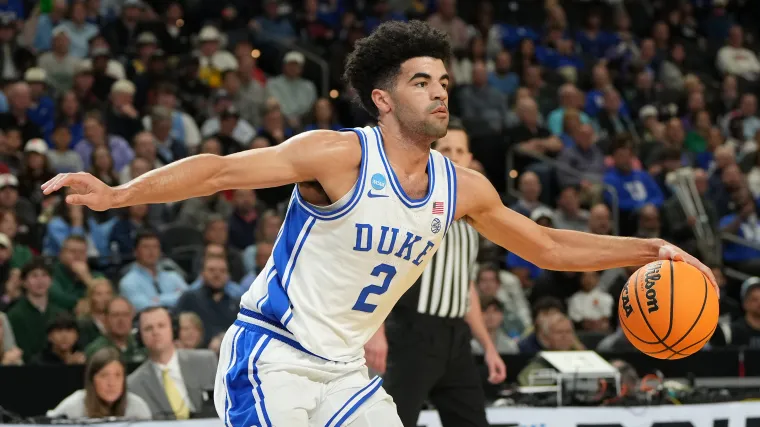
The Duke Blue Devils’ 2026 recruiting class is currently riding high, boasting a consensus No. 1 ranking. Among the talented prospects committed, a crucial piece of the puzzle appears to be in place at the point guard position: Deron Rippey Jr., a 6-foot-2 McDonald’s All-American from Blair Academy in New Jersey. This addition is particularly significant when considering Duke’s recent postseason history.
Over the past two seasons, the Blue Devils have demonstrated an ability to recruit top-tier talent and secure numerous victories. However, the elusive championship trophy has remained just out of reach, a pattern many observers attribute to a lack of a true floor general.

The Recurring Point Guard Problem
The evidence supporting this theory is mounting with each passing March Madness.
- The 2025 Final Four Collapse: A year ago, Duke squandered a 14-point lead in the final eight minutes against Houston in the Final Four. This was despite fielding a team with future NBA rookies Cooper Flagg and Kon Knueppel, while Houston lacked a single first-round draft talent. The inability to manage the game’s closing moments proved costly.
- The 2026 Elite Eight Exit: Just recently, the Blue Devils faced a similar fate in the NCAA East Region final against Connecticut. They held a commanding 19-point lead with just over three minutes remaining in the first half, a 10-point advantage with under seven minutes to play, a 5-point lead with less than two minutes on the clock, and were up by two points with only six seconds left. Despite these significant leads, they were ultimately eliminated just short of the Final Four in a heartbreaking 73-72 loss.
In both of these critical games, Duke relied on players who were not natural point guards to run the offense. This strategy worked for much of the regular season but faltered when it mattered most.
Beyond the Box Score: The Point Guard’s Crucial Role
The impact of not having a dedicated point guard is evident when examining the performances of key players.
- Caleb Foster’s Contribution: This past season, Caleb Foster was the player tasked with initiating the offense. While a highly capable college basketball player, Foster is not a traditional point guard. His mental toughness was undeniable, as he played significant minutes in crucial NCAA tournament games despite a broken foot sustained just weeks prior. Over the season, he shot an respectable 39% from three-point range and 45% from the field. However, his average of just 2.8 assists per game highlights his limitations in orchestrating the offense for his teammates.
- Sion James’s Role in 2025: The previous year, Sion James found himself in a similar situation. James is a valuable player, having appeared in 74 games for the Charlotte Hornets this season. However, his role with the Hornets is not that of a primary ball-handler. Similar to Foster and All-American Cameron Boozer this season, Flagg was the true playmaker for Duke. James’s primary function was to advance the ball and get it into the hands of the star players to make key decisions. In the critical Houston game, he committed two turnovers while attempting to inbound the ball against full-court pressure, and notably, recorded no assists.
Cayden Boozer: A Missed Opportunity?
Cayden Boozer, a freshman this past season, is a point guard by trade. Earlier in the year, as Duke’s struggles in late-game situations became apparent, there was a suggestion to hand the reins of the offense to Cayden, allowing him to develop into the team’s definitive floor general. This transition did not fully materialise, with the offense largely remaining Foster’s domain.
Cayden did enter the starting lineup when Foster was injured, but the offense still predominantly flowed through Cameron Boozer, regardless of his on-court position. This approach was understandable given the timing of Foster’s injury, occurring deep into March. Reinventing a team’s offensive structure at such a critical juncture is fraught with risk, especially when the team had only lost twice in 37 games operating in their established manner.
The Championship Drought and Assist Numbers
Duke’s championship drought extends back to 2015, and their offensive strategy has seen variations of this same approach since then. In the twelve seasons since their last title, Duke has only had a player average more than 5 assists per game on four occasions. In eight of those seasons, the team’s assist leader was not a true playmaker, with three instances of a frontcourt player leading in this category.
The UConn Game’s Final Moments
The final seconds of the Elite Eight game against UConn offer a stark illustration of the potential consequences of not having a poised point guard at the helm. Had the team been built around Cayden Boozer’s strengths, it’s a matter of speculation whether he would have known to:
- A) Hold the ball and draw a foul in the final five seconds, or
- B) Allow the clock to expire rather than attempting a risky pass into the frontcourt.
These are precisely the types of high-pressure decisions that point guards across the sport routinely make.
Instead, in the closing moments, with the ball in his hands after UConn had narrowed the deficit to two points with ten seconds remaining, Cayden was met with a double-team. In attempting to force a pass over outstretched arms, the ball was deflected by Silas Demery and recovered by Braylon Mullins beyond midcourt. This was Boozer’s third turnover of the game, contributing to the team’s total of thirteen, shared with Foster.
Tragically, this sequence left Cayden as a spectator, some twenty feet away, as Mullins launched a desperate three-pointer from near midcourt, a shot that would become the defining moment of the 2026 NCAA Tournament.
With Caleb Foster still a junior and Cayden Boozer a freshman this past season, Duke has the potential to enter the 2026-27 season with two players possessing some level of point guard experience, alongside the highly-touted Rippey Jr.
However, for Duke to break its championship drought, a player with an innate understanding and command of the game’s most crucial position will need to emerge. Otherwise, the Blue Devils may find themselves watching a familiar script unfold once again: a dazzling start, a compelling build-up, and ultimately, a disappointing conclusion.