Sheffield Shield Final: A Nail-Biting Finish Hangs in the Balance
The Sheffield Shield final is living up to its billing as a contest too close to call, with South Australia dramatically seizing the momentum late on day four. Chasing 196 for their first Shield title since the 2018-19 season, the Redbacks found themselves at 5-102 at stumps on Sunday at Melbourne’s Junction Oval, with nightwatchmen Todd Murphy and Mitch Perry yet to face a ball.
Victoria had appeared to be in a strong position, recovering from a shaky start and reaching 3-102 with less than 20 minutes remaining in the day. However, crucial wickets fell in successive overs, shifting the pressure back onto the hosts.

A Tumultuous End to Day Four
The turning point came when Henry Thornton struck, removing Peter Handscomb for 28. This ended a vital 67-run partnership that had looked set to steer Victoria towards victory.

Moments later, Marcus Harris was caught by Ben Manenti at second slip off the bowling of Liam Scott for 35. These twin dismissals plunged Victoria back into trouble at five wickets down, leaving the match delicately poised heading into the final day.
South Australia’s Resilience in the First Innings
Earlier in the match, South Australia had demonstrated their fighting spirit. Resuming their second innings at 5-94, they slumped to 7-122, facing a precarious lead of just 59 runs. With Scott Boland on a hat-trick, a quick end to the innings seemed likely.
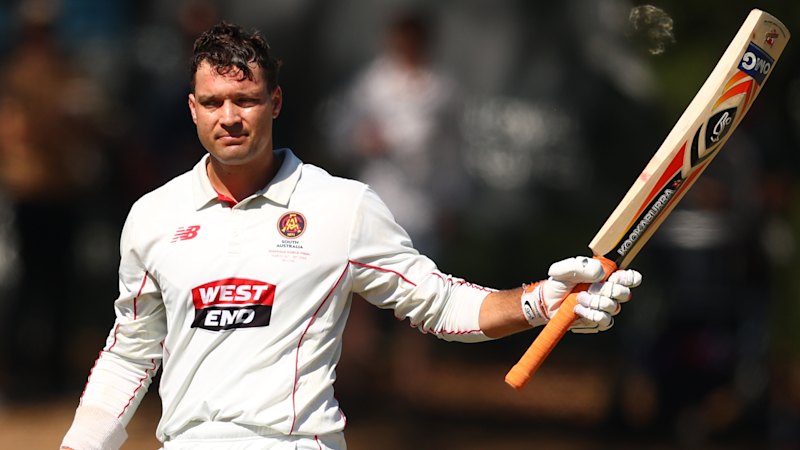
However, a resolute partnership between Alex Carey and Nathan McAndrew stemmed the tide. They put on a crucial 105 runs for the eighth wicket, with McAndrew eventually departing for a valuable 60. Carey, demonstrating his class and experience, went on to score an unbeaten 103, guiding South Australia to a total of 258 before being the last man out. Carey’s century was a significant contribution, mirroring his match-winning performance in the previous season’s Shield final. He compiled his commanding 168-ball innings with six fours and a six.
Victoria’s Early Charge and the Substitute Controversy
Nathan McAndrew also played a significant role earlier in the match, claiming wickets in successive overs at the start of Victoria’s run chase. This had the home side in early strife at 3-35. The partnership between Handscomb and Harris then emerged, seemingly putting Victoria in control of the chase.
The Sheffield Shield final has been seasoned with drama, none more so than the controversial injury substitute rule. South Australia’s coach, Ryan Harris, labelled the rule “a shit rule,” though he admitted his side had considered using it themselves. This rule played a pivotal role in shifting the momentum on day three.
After being in a difficult position midway through day three, Victoria managed to snare five wickets after tea, leaving the reigning champions, South Australia, on the ropes. SA were 5-94 in their second innings, holding only a slender overall lead of 31 runs with two days remaining. To secure back-to-back titles, South Australia must win this final.
The Substitute Rule’s Impact
The controversy unfolded after Victoria was dismissed for 261 in their first innings. Paceman Sam Elliott sustained a hamstring injury during the tea break. This triggered a flurry of activity, with Victoria activating Mitch Perry as an injury substitute. However, Perry was initially denied permission to warm up in the nets, leading to confusion. Victorian assistant coach Ben Rohrer was also initially barred from fielding until Perry was ready to enter the field.
When Perry finally took the field, he made an immediate impact, dismissing SA captain Nathan McSweeney with his first delivery, leaving the Redbacks in disarray at 3-35.
“It’s always frustrating when it’s against you,” Harris commented. “So it’s a shit rule unless you make the most of it. In saying that, we could do the same – we’re allowed to do the same until the end of play. I’m an old-fashioned Test cricketer. You get injured and you’re a bowler down. But in saying that, what happened today is the rule. Whether it’s right, I don’t know, it’s not for me to say.”
Harris also pointed out that the rule had been in place for the entire Shield season and that South Australia had contemplated bringing in Wes Agar as their own tactical substitute after Perry was activated. Adding to the intrigue, Perry had originally been omitted from Victoria’s Shield final squad to make way for Elliott.
“I was pretty cooked after about two and a half overs,” Perry admitted. “It was a bit of a shock to the system.”
With the match hanging precariously, SA required a significant turnaround. Test wicketkeeper Alex Carey was 24 not out at stumps, with Liam Scott, the Sheffield Shield player of the season, on two.
“We just have to make sure tomorrow we try to make the most of it and get as many as we can … and defend it like it’s literally the end of our lives, I guess,” Harris stated. “We just fight our butts off.”
Victorian captain Will Sutherland had a productive day, capping it off by having Jason Sangha caught behind for 34. Earlier, Fergus O’Neill and Sutherland had spearheaded Victoria’s recovery after lunch, wresting momentum back from South Australia and establishing a first-innings lead of 63 runs. O’Neill top-scored for Victoria with an unbeaten 64 from 134 balls, his fourth first-class half-century.
The day’s play had been delayed by over an hour on Saturday morning due to persistent rain. Victoria reached lunch at 5-150. Marcus Harris added no further runs to his overnight score before feathering an edge off Scott and being caught behind for 40, leaving Victoria precariously placed at 6-157 in reply to SA’s 198. However, O’Neill and Sutherland’s 55-run partnership pulled Victoria out of immediate trouble. Sutherland, who had taken four wickets in SA’s first innings, contributed 34 runs from 57 balls. The Victorian skipper gave his side the lead with a powerful pull shot for six off Jordan Buckingham.
Bowlers Dominate as Batting Averages Suffer
The Sheffield Shield final has also highlighted Australia’s ongoing search for a reliable opening batsman. With national selectors present, the intel gathered from the early stages of the match offered little clarity. Victoria held a slight advantage after two days, being 4-110 in reply to South Australia’s 198. However, the most significant takeaway was the continued uncertainty surrounding the top-order batting positions, with incumbent Test opener Jake Weatherald remaining a benchmark by default.
In the three months since Weatherald relinquished his Test spot, no candidate has truly seized the opportunity with a consistent stream of runs late in the season. In the challenging batting conditions presented, former Test opener Nathan McSweeney and emerging talent Campbell Kellaway both failed to significantly strengthen their cases, despite not hurting their prospects.
With selector Tony Dodemaide observing from the stands and national coach Andrew McDonald monitoring from Cricket Victoria’s function room, McSweeney displayed grit for three hours (across two days) to post a game-high 52. McSweeney, who endured a difficult series against Jasprit Bumrah last season, has had a trying Shield campaign but showcased his class on a difficult pitch. While many batters resorted to aggressive tactics on a bowler-friendly surface, McSweeney relied on his defensive technique against a quality Victorian attack spearheaded by Scott Boland.
It was a trademark Boland delivery that eventually accounted for McSweeney. Caught between two minds by a ball in the channel outside off-stump, he edged to a diving Sam Harper. Campbell Kellaway, after surviving 24 overs of high-quality seam bowling in dull light, edged a sharply rising delivery from Henry Thornton to McSweeney running to short cover.
Scoring has been exceptionally difficult on a well-grassed pitch offering sharp bounce and significant seam movement, a challenge that even tested Alex Carey. The Test gloveman managed 26 runs off 88 balls before playing on to Sam Elliott, whose breakthrough significantly vindicated his selection over the unlucky Mitch Perry. A pivotal moment arrived when Victorian skipper Will Sutherland bowled Liam Scott for 37, limiting South Australia to 198 and denying them any batting bonus points. This meant that if Victoria surpassed 200, they would only need a draw to secure the Shield title. A draw, however, appeared unlikely, despite rain being forecast for Saturday.
Victoria’s response had been unconvincing. Sam Harper provided a brief cameo, scoring 20 off the bat against the new ball, but was dismissed after just 10 balls, getting into an awkward position and edging. Across the first two days of this marquee domestic fixture, only eight overs of spin have been bowled, doing little to alleviate concerns about the declining appreciation for the art of slow bowling.
T-Shirt Controversy on Day One
The Sheffield Shield final also saw an unusual incident on day one, involving a fan denied entry for wearing a T-shirt supporting Imran Khan. Cricket Australia later clarified that the fan would be allowed entry as the shirt was deemed to represent a humanitarian issue. Luke Brown was initially asked to cover his “Free Imran Khan” shirt to gain entry to Junction Oval, as it was interpreted as a political statement regarding the jailed Pakistani leader.
However, upon being contacted, Cricket Australia stated that while security staff had followed protocol, a review of the situation determined that the treatment of Imran Khan was not viewed as a political issue, and therefore, support for him did not contravene the governing body’s ticket and entry conditions.
“Given the widespread concern in the cricket community for Imran Khan’s welfare, we believe this is a humanitarian issue and will act accordingly,” a CA spokesperson said. Widespread concern exists regarding Imran Khan’s health following reports of his deteriorating condition in Rawalpindi’s Adiala prison, where he is incarcerated on corruption charges. A petition, drafted by batting legend Greg Chappell and signed by 14 former international captains from five Test nations, including Australian greats Steve Waugh and Allan Border, called for improved prison treatment for Imran Khan. Other signatories included Australia’s Belinda Clark, former Indian captains Kapil Dev and Sunil Gavaskar, and West Indies icon Clive Lloyd.
Imran Khan, a revered figure in cricket globally, achieved arguably his finest on-field success in Melbourne 34 years ago, captaining Pakistan to their sole World Cup victory. Brown expressed his bewilderment at being asked to cover the T-shirt, produced by the cricket website Cricket Et Al. He was eventually permitted entry after wearing another shirt over the top.
“I was surprised,” Brown, a club cricketer for approximately 30 years, told this masthead. “I understand the argument they have to deal with other situations, so it just makes it easier for them if they apply a blanket rule. They were very nice. I can see why they made that call, but I think it’s the wrong one. The cricket world should be getting behind him. It’s up to them how they enforce their rules, but if they’re going to do this, then it puts a bigger onus on them to do more on other fronts to mobilise the cricket public to support Imran Khan.”
Brown later commended CA for their clarification. “It’s easy for individual cricket fans like me to take the right stance on Imran’s treatment,” he said. “It’s harder for Cricket Australia, so I applaud them for doing so.”
On the opening day, Victoria held an early advantage, claiming three wickets to have South Australia at 3-55 at lunch. Only 28 overs were bowled for the entire day, with no play after the first break due to persistent rain in the afternoon.