Gallium Discovery Bolsters Springfield Project’s Economic Outlook for Pioneer Minerals
The discovery of gallium at the Springfield prospect, part of Pioneer Minerals’ (ASX:PMM) North Pine project in Idaho, presents a significant opportunity to enhance the project’s economic viability. This finding diversifies Pioneer’s critical minerals development strategy, complementing its existing focus on tungsten. The identification of gallium, a metal crucial for advanced technologies, aligns perfectly with United States strategic imperatives and addresses pressing supply chain vulnerabilities.
Gallium is an indispensable component in a range of high-demand sectors, including semiconductors, defence and radar systems, 5G telecommunications, and renewable energy technologies. Despite its critical importance, domestic supply within the US and its allied nations is severely limited, with China currently dominating global production.

“The identification of widespread gallium mineralisation represents an important development for Springfield,” stated Michael Beven, CEO of Pioneer. “These results highlight the presence of a broader multi-commodity system, with gallium occurring in a separate mineral phase and potentially offering an additional recoverable product stream.”
Beven further elaborated on the strategic implications: “As global demand for critical minerals continues to grow, Springfield is emerging as a strategically positioned project aligned with US supply chain priorities.”
The recent rock chip sampling program not only confirmed robust tungsten assay results but also revealed widespread gallium enrichment across the prospect.
Uncovering the Gallium Potential: A Deeper Dive into the Rock Chips
The initial analysis of rock chip samples, conducted in December 2025, focused on tungsten and gold using sodium peroxide fusion and fire assay methods. Gallium was not part of the original analytical suite. However, preliminary metallurgical testwork identified elevated gallium values within the processing streams. This prompted Pioneer to re-examine the original sample set for the presence of gallium.
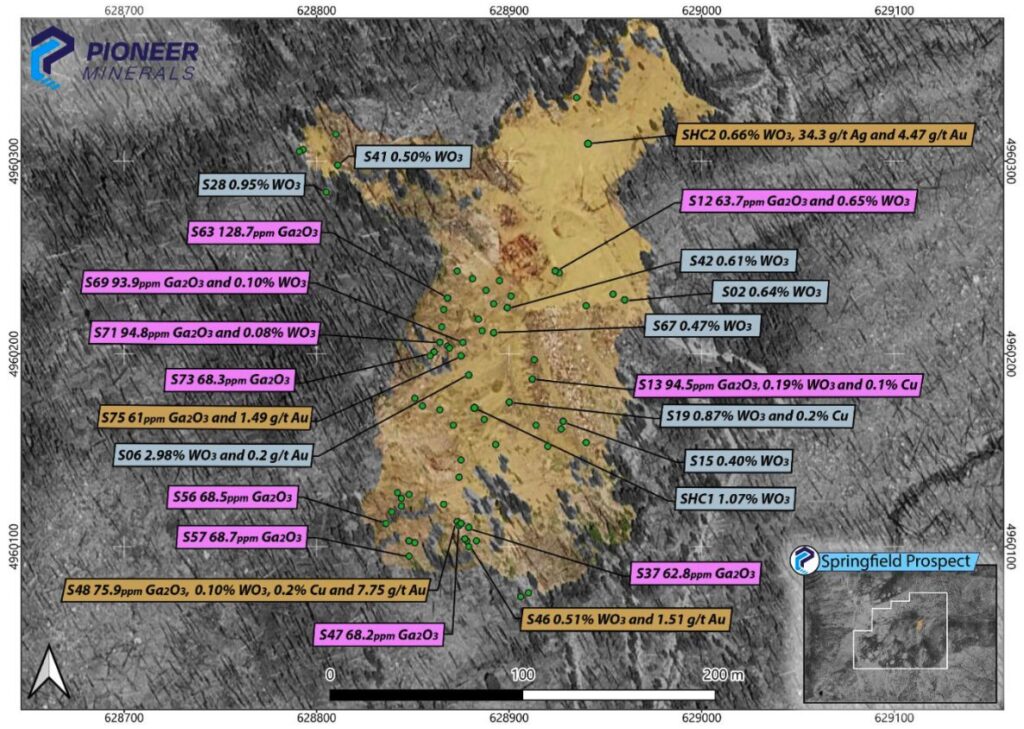
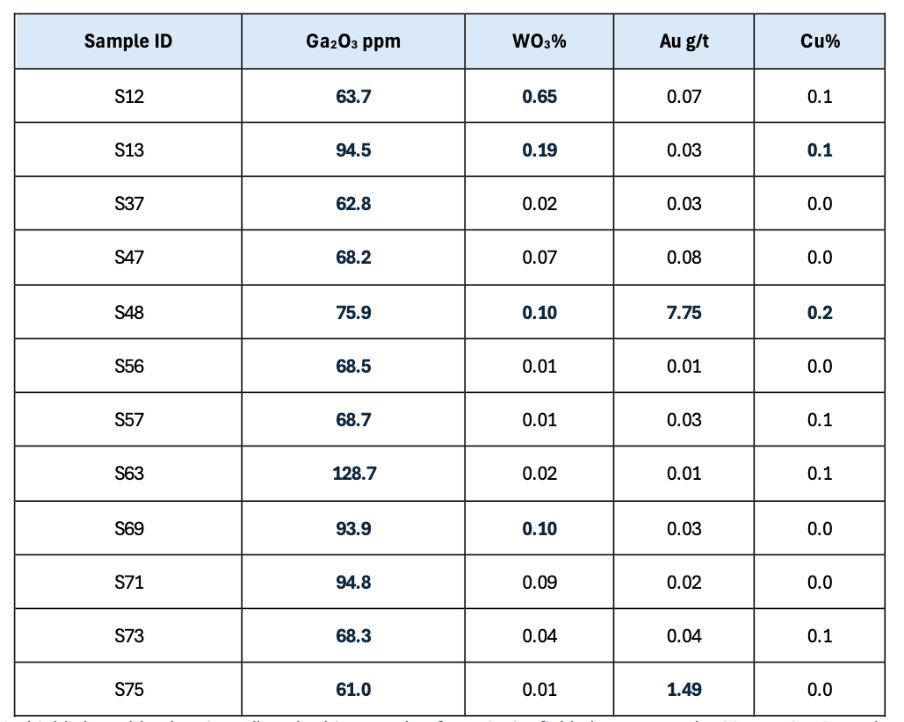
Pulverised samples from the initial rock chip program were subsequently re-assayed using a mixed acid digest method. This targeted approach confirmed the presence of widespread gallium mineralisation throughout the Springfield prospect. The results showed multiple samples returning values exceeding 60 parts per million (ppm) Ga₂O₃, with peak values reaching over 120 ppm Ga₂O₃. This data has successfully defined a coherent gallium anomalous footprint.
Crucially, the gallium mineralisation does not appear to correlate with tungsten (WO₃). Furthermore, it was not concentrated during beneficiation testwork, strongly indicating that gallium is hosted in a distinct mineral phase. This suggests that gallium is a previously unrecognised, yet significant, component of the Springfield mineral system.
Next Steps: Defining Gallium Deportment and Recovery Pathways
Pioneer’s immediate focus will be on conducting detailed geochemical and mineralogical studies. These investigations are designed to pinpoint the specific mineral phase hosting the gallium and to map its distribution within the Springfield system.
“Our next phase of work will focus on defining gallium deportment and evaluating practical recovery pathways alongside our tungsten development strategy,” Beven confirmed.
To support exploration efforts, Pioneer is commissioning an electromagnetic (EM) survey. This survey aims to identify conductors associated with sulphide mineralisation and is anticipated to be completed between April and May.
Phase 1 beneficiation testwork is currently underway with Mineral Technologies, with results expected in April. This testwork will provide crucial insights into the physical and chemical characteristics of the ore.
In parallel, Pioneer is taking steps to reopen the historic mine road. This initiative will significantly improve access for ground-based exploration crews, streamlining future fieldwork.
A Look Back: The Historical Context of Springfield
The Springfield prospect has a historical connection to tungsten production. Approximately 1,900 feet of diamond drilling were previously completed to define the tungsten mineralisation, which was readily visible in the rockface. During the 1950s, tungsten production at Springfield was supported by a US government subsidy. Historical records indicate that 39,000 tons of ore were mined, yielding an average of 0.35% to 0.40% WO₃. This resulted in the sale of 1,522 short ton units (stu) of high-grade concentrate, grading over 70% WO₃. An additional 2,159 stu of lower-grade concentrate and 8 tons of material grading over 9% were sent to the Salt Lake Tungsten Co.
Integrating Gallium into the Development Strategy
Pioneer’s ongoing metallurgical testwork will now incorporate an assessment of potential recovery pathways for gallium. This will involve evaluating secondary processing and hydrometallurgical options. The findings from this testwork will be integrated into the broader processing and development strategy, alongside plans for near-term tungsten concentrate production.
Concurrently, Pioneer will continue to engage with US government funding initiatives. These programs specifically target critical minerals, aiming to reduce reliance on China’s dominant market position and strengthen domestic supply chains. This strategic alignment with US government priorities further enhances the project’s prospects.