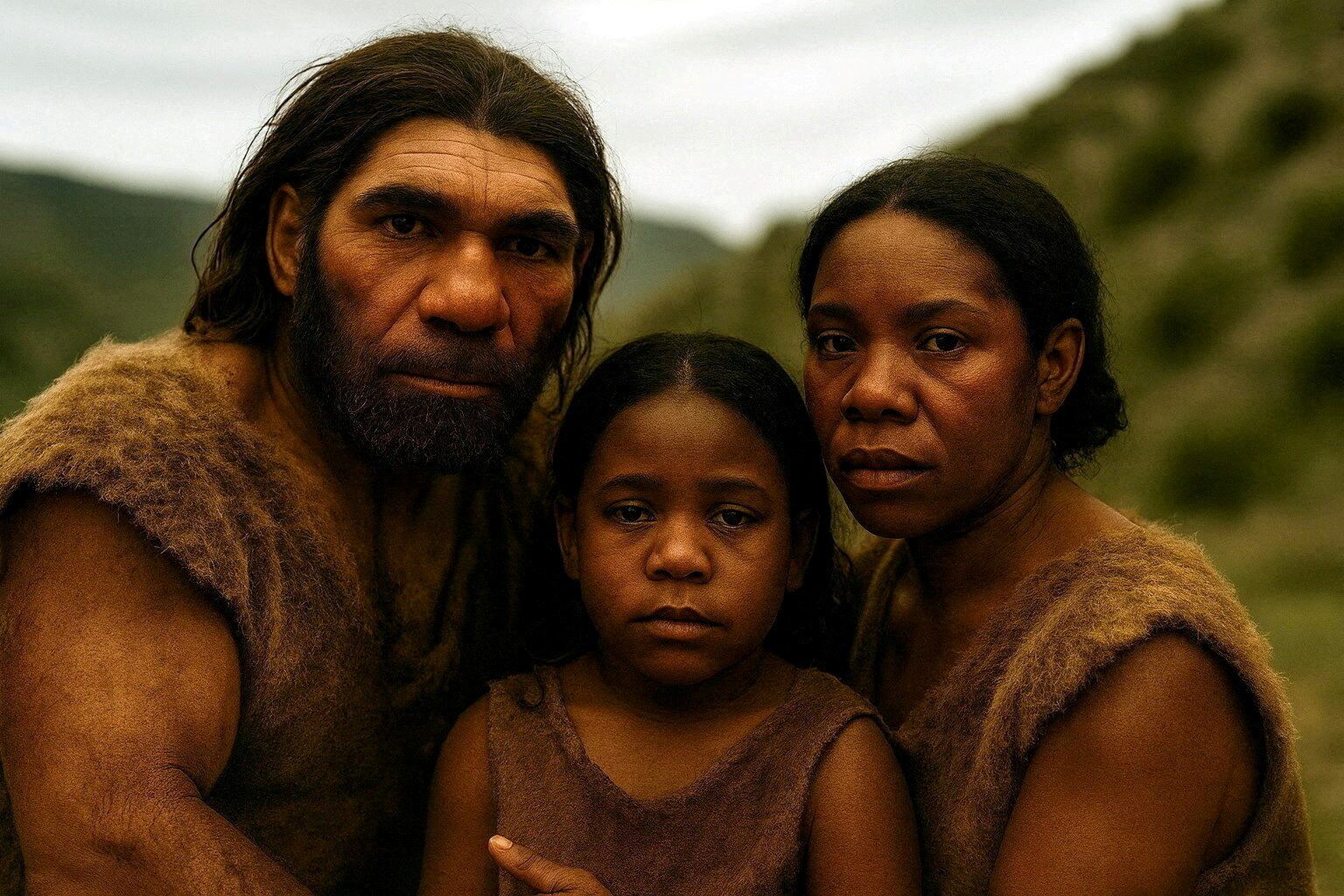
For millennia, our ancestors walked the Earth alongside Neanderthals. Around 60,000 years ago, these two distinct human species, Homo sapiens and Neanderthals, not only coexisted but also interbred, leaving a lasting genetic legacy in modern populations. The descendants of Homo sapiens who ventured out of Africa and settled in Europe and Asia carry within their DNA the faint echoes of these ancient unions. Today, individuals of modern human ancestry outside of Africa possess approximately 2% Neanderthal DNA.
However, a curious genetic anomaly has long puzzled scientists: this Neanderthal genetic imprint is conspicuously absent on the X chromosome, the sex chromosome that determines female gender. This “missing trace” has remained an enduring enigma in the scientific community.

Now, a groundbreaking study from the University of Pennsylvania in the United States, published in the prestigious international journal Science, offers a compelling explanation for this long-standing mystery. The findings suggest that the directionality of interbreeding played a crucial role.
A Shift in Understanding Ancient Human Encounters
The prevailing scientific hypothesis for the absence of Neanderthal DNA on the X chromosome previously leaned towards biological incompatibility. This “gene desert” theory posited that Neanderthal genes on the X chromosome were detrimental to Homo sapiens, leading to their elimination through natural selection.
However, the University of Pennsylvania research team approached the analysis of Neanderthal genomes with a fresh perspective. Their results challenged existing assumptions. Contrary to the incompatibility theory, the researchers discovered that Neanderthal X chromosomes actually contained a significantly higher proportion – 62% more – of modern human DNA compared to other Neanderthal chromosomes. If incompatibility were the primary factor, one would expect to see less modern human DNA on Neanderthal X chromosomes, a finding that directly contradicts and undermines the “gene desert” hypothesis.
The Key Lies in Sex Chromosome Transmission
The research team employed sophisticated mathematical models and simulations to explore the dynamics of interbreeding between Homo sapiens and Neanderthals. Their simulations demonstrated that the observed genetic pattern, with a scarcity of Neanderthal DNA on the modern human X chromosome, emerged precisely when unions between Homo sapiens females and Neanderthal males were more frequent than the reverse.
The biological mechanics of sex chromosome inheritance provide a clear rationale for this phenomenon. Females possess two X chromosomes, one inherited from their mother and one from their father. Males, on the other hand, have one X chromosome (inherited from their mother) and one Y chromosome.
Consider a scenario where a Homo sapiens female mates with a Neanderthal male. Their female offspring would inherit an X chromosome from each parent. If these daughters then grew up within a Neanderthal community and reproduced, the Homo sapiens X chromosomes would readily propagate within the Neanderthal population. Conversely, if unions between Neanderthal females and Homo sapiens males resulted in fewer female offspring, or if these daughters were less likely to reproduce within Homo sapiens groups, then the opportunities for Neanderthal X chromosomes to enter the Homo sapiens gene pool would be significantly diminished. This differential transmission, dictated by the rules of sex chromosome inheritance, explains the directional bias observed in the genetic legacy.
Beyond Attractiveness: Social Structures as a Driving Force
Senior researcher Alexander Platt emphasized that these findings do not suggest any inherent difference in attractiveness between the two species. Instead, he proposed that the observed pattern likely stems from differences in social structures or cultural practices prevalent at the time.
Platt posited that social dynamics may have facilitated unions in one direction, or that distinct migration patterns between genders could have influenced the frequency of interbreeding. For instance, if Neanderthal males were more prone to migration or integration into Homo sapiens groups, or if Homo sapiens females were more likely to integrate into Neanderthal communities, this could explain the observed genetic asymmetry.
The research team views this discovery as a crucial stepping stone towards a deeper understanding of ancient human social organization. They intend to leverage these genetic insights to further investigate historical patterns of human migration and social integration, seeking to determine whether women typically remained within their birth communities while men moved between tribes, or vice versa, thereby influencing the spread of their genes across populations. This research opens new avenues for reconstructing the complex social lives of our ancient ancestors.