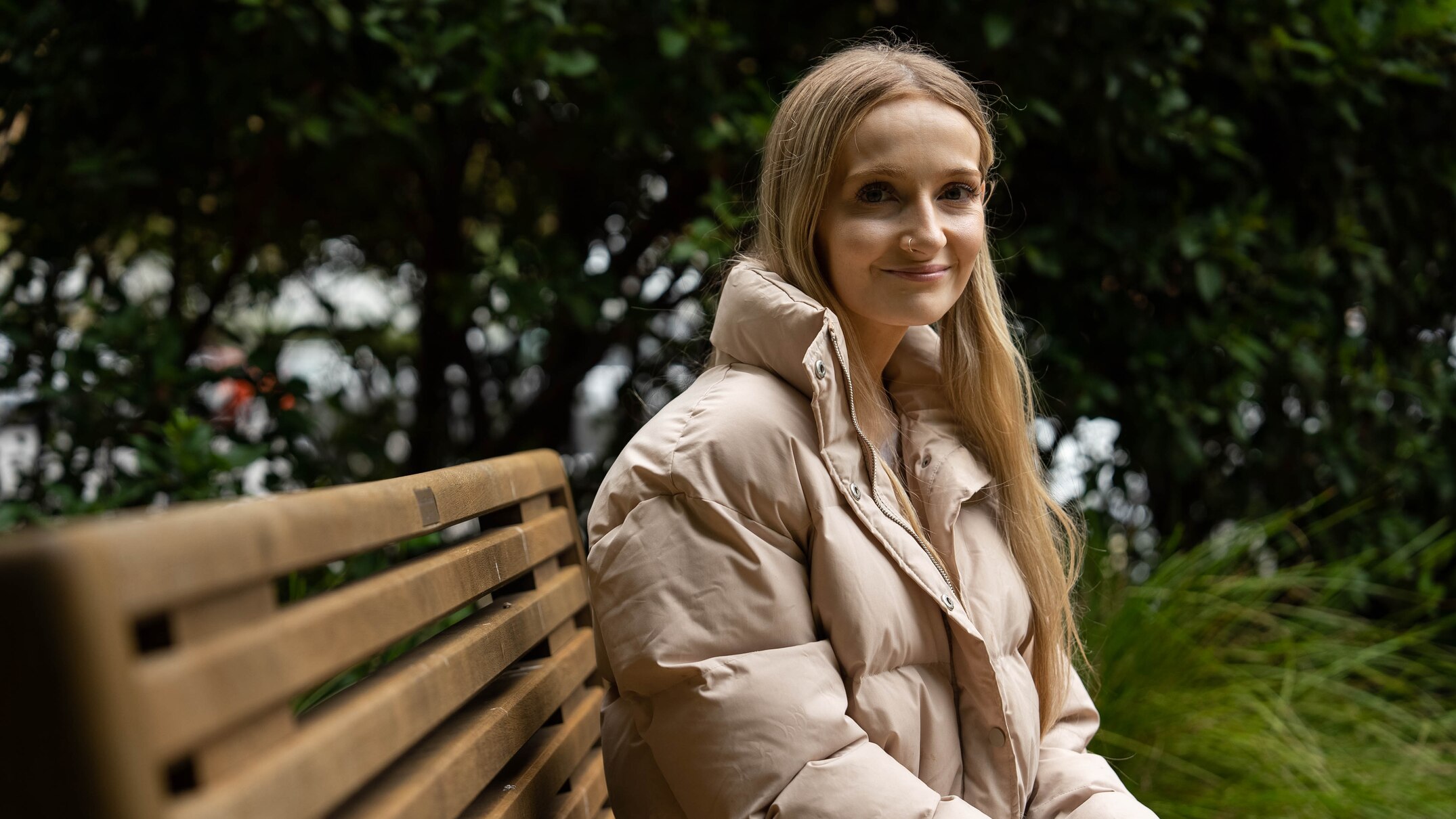

When Annaliese Holland, known to her friends and family as Annie, was given a prognosis of just one year to live, her reaction was not one of despair, but of celebration. At 26 years old and hailing from Adelaide, Annie is navigating the final months of her life with a remarkable blend of courage and openness, choosing to use her remaining time to foster honest conversations about end-of-life care for young Australians.
“It was a really happy thing,” Annie shared in an interview. “When you’ve been sick for such a long time, it becomes something that’s not so scary. It sounds strange, but it’s incredibly empowering.”

While the stark reality of her limited time might seem grim, Annie’s warm and vibrant personality shines through. She admits to moments of vulnerability, acknowledging, “If I really think about it at night, it kind of f***s with me. We don’t know what happens after we close our eyes. So I’m a little scared, in that sense.” Yet, she quickly rebounds with a characteristic laugh, exclaiming, “I’m dying! We need to talk about it.”
Understanding Voluntary Assisted Dying in Australia
Voluntary Assisted Dying (VAD) is a legal option in every Australian state and territory, with the exception of the Northern Territory. This framework provides eligible adults grappling with an advanced, incurable illness the opportunity to request medical assistance to end their life. The specific legislative requirements can vary slightly across jurisdictions, but a common thread is the stipulation that patients must be living with a condition predicted to cause death within a six to twelve-month timeframe, as determined by two specially trained medical practitioners.
Annie has already selected the date for her passing but has opted to keep it private. Her primary concern is the well-being of her loved ones. “The most important thing is protecting my family,” she explained. “I went through this with one of my gorgeous friends, and I saw the outcome of what happens when the public knows. It was messy.”
A Life Defined by Chronic Illness
Annie’s journey has been marked by chronic illness since her early years. At 18, she received a diagnosis of Autoimmune Autonomic Ganglionopathy (AAG), a rare condition where the immune system attacks the autonomic nervous system. While not always fatal, Annie’s condition had progressed significantly by the time of her diagnosis, leading to severe damage.
“At that point, my suffering was so much and I’d become such a shell of myself that I realised quality is so much more important than quantity,” she recounted. Her daily reality involves enduring over a dozen injections for pain relief and constant vomiting. She estimates spending approximately 17 hours a day confined to her bed or couch. The progressive nature of her illness has also led to the planned removal of her teeth due to her jawbone dissolving.
Feeding herself intravenously has become a necessity, but Annie is now reliant on her last accessible vein, as others have become infected or blocked. “If I get a clot in it there’s no way to feed me and basically I will die through starvation,” she explained with a heavy heart. “I’ve watched others with my disease go through that and it’s a horrible way to go.”
A Shifting Perspective on End-of-Life Choices
Just a few years ago, the concept of voluntary assisted dying might have seemed an unlikely choice for Annie. “I used to be one of those people who was actually against voluntary assisted dying,” she admitted. “It wasn’t until I got sick that my views on it completely changed.”
Her perspective shifted dramatically after meeting Lily Thai, a 23-year-old also battling AAG, who chose VAD shortly after South Australia’s laws came into effect in 2023. “We just had the most beautiful friendship in that time and spent nearly every day together,” Annie reminisced. “I pinky-promised her I’d do anything she wanted me to do, so I held her hand as she underwent VAD. She was so ready and so brave.”
A pivotal moment for Annie occurred last year when she suffered sepsis after major surgery and required resuscitation. “It was the first time I was more terrified of being around in five years time, than I was to die,” she confessed. It was then she told her father, “I’ve had enough. I can’t do this.” While initially fearful of her giving up, her father ultimately supported her decision to pursue VAD. “He came and sat on my bed and we burst into tears,” she said. “When you’re unwell, it doesn’t just affect you, it affects your entire family.”
The “F*** It” List: Embracing Life’s Final Chapter
Despite her limited time, Annie is determined to seize every opportunity. She has compiled a “f*** it” list, her personal take on a bucket list, detailing experiences and accomplishments she wishes to achieve before her passing. This list includes celebrating her wedding earlier this year.
A deeply personal aspiration is to witness a birth and hold a newborn baby. “I’m OK with dying, but the bit that gets me is the fact that I’ve always wanted to be a mum,” she shared. “All of my friends and girls my age are having babies and I can’t do that.”
Advocating for Open Dialogue and Choice
Another item on Annie’s list is a “celebration of life” rather than a traditional funeral. She has already curated a playlist for the occasion, featuring artists like Lily Allen, The Beatles, and “Over the Rainbow.”
Annie also intends to document her end-of-life journey, hoping to offer guidance and support to others contemplating a similar path. She strongly advocates for future changes, particularly regarding more open discussions about voluntary assisted dying with patients. Current South Australian law prohibits doctors and other healthcare practitioners from initiating conversations about VAD or suggesting it to patients they are caring for, with potential disciplinary action for those who do.
“If you don’t know about it, you don’t know it’s a choice,” Annie asserted. She has encountered healthcare professionals with personal objections to VAD, leading to some difficult conversations. “I had a bit of a fight with a few doctors about it because not everyone believes in it,” she said. “But it’s something that needs to be spoken about and needs to be brought up because it is a choice and no-one’s saying you have to do it.”
Annie’s Legacy: Living Fully and Freely
As her time draws near, Annie plans to be surrounded by her loved ones and her “beautiful” doctor, Chloe Furst, who will administer the VAD. “They’ve told me that I can have as many people there as I want.” Annie observes that her time is approaching as she notices the subtle changes that define her sense of self diminishing. “The way I look and sound… lots of little bits of me. Those things are really important.”
Beyond encouraging more open conversations about death and end-of-life planning, Annie’s ultimate wish is for young Australians to embrace her advice to live life to its fullest. “Forget about the bulls***,” she urged. “If you’re not happy, do something to change it, and do whatever that takes.”
Annie acknowledges the profound difficulty of contemplating a world that will continue without her. She hopes that her memory will be cherished positively and serve as an inspiration. “I just want people to remember me as me, not my illness,” she stated with unwavering pride. “I have fought f***ing hard and I want everyone to see that because I’m proud.”