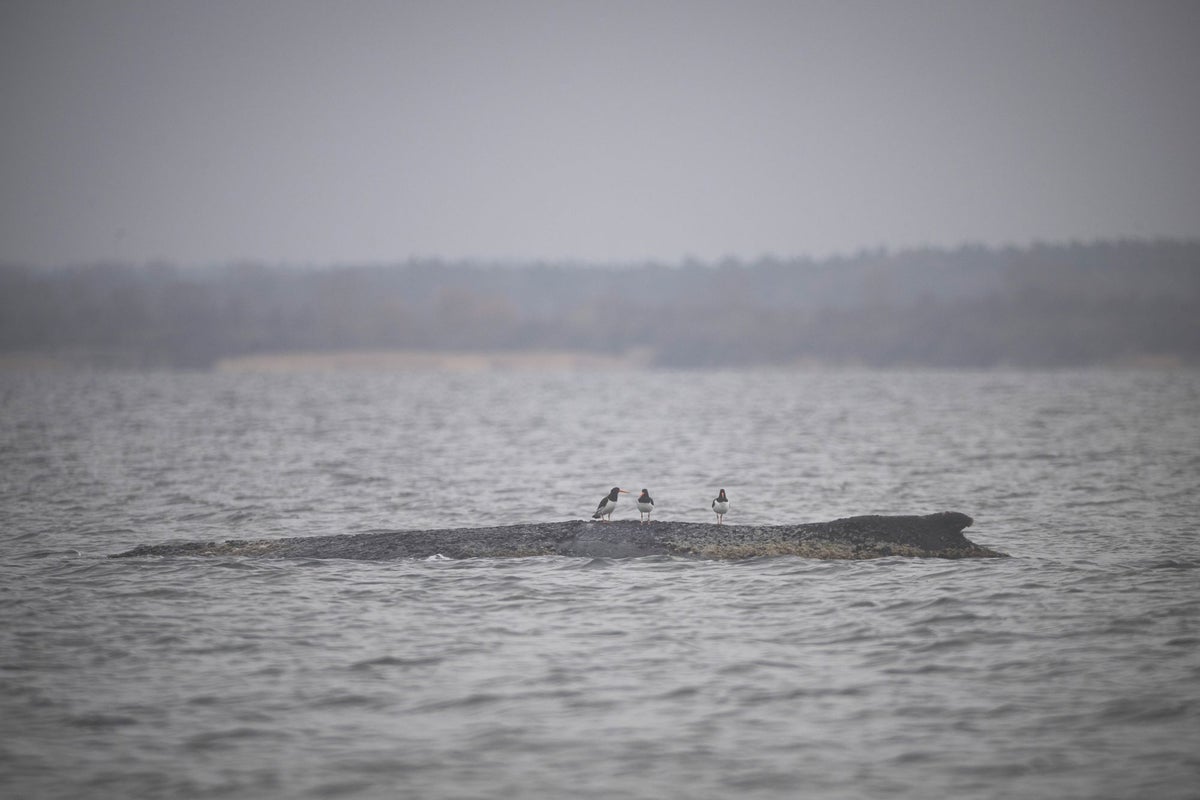
Stranded Humpback Whale Fights for Survival in Baltic Sea
A critically weakened humpback whale, trapped in Germany’s Baltic Sea, faces diminishing chances of returning to the vast Atlantic. Despite multiple rescue attempts, the majestic creature appears to be losing its strength, raising grave concerns among marine experts.

Authorities have established a 500-metre exclusion zone around the whale, hoping to provide it with the necessary peace to recover and potentially find its own way out. This decision was announced at a press conference in Wismar, a coastal town in eastern Germany, where the whale has become a focal point of national attention.
“If he can regain his strength, he will be able to make his own way out,” stated Till Backhaus, the environment minister for the state of Mecklenburg-Pomerania. “This is why we’ve chosen to give him space, allowing him the opportunity to set off and successfully leave this area.”
However, Backhaus also acknowledged the grim reality: “We must also assume that he is weakened. And he is also sick.” Concerns of injury have been raised, with speculation that the whale may have become entangled in a fishing net.
Earlier in the week, the 12-15 metre whale captivated the nation as it was stranded off a sandbank at Timmendorfer Strand beach and later in Wismar Bay. Rescue efforts, involving excavators and boats creating waves to encourage the whale to swim free, were extensively covered by the media, with live streams and news alerts keeping the public updated. The whale’s plight became a widespread topic of conversation, with many exchanging messages about the ongoing rescue operations.
But as the days pass, optimism is fading. Experts are observing a significant decline in the whale’s activity. Stefanie Groß from the Institute for Terrestrial and Aquatic Wildlife Research at the University of Veterinary Medicine Hannover noted, “It is very noticeable that the animal is showing significantly less activity. Its respiratory rate has dropped considerably. The animal is not moving. It did not react even when we drove closer.”
The reasons behind the whale’s unusual journey into the Baltic Sea remain unclear. Some theories suggest it may have become disoriented while pursuing a shoal of herring or lost its way during migration. As it is likely a male, this could also play a role in its navigational errors.
The Perils of the Baltic
The Baltic Sea presents a hostile environment for the humpback. The water’s salinity is not sufficient for the marine mammal’s long-term survival, and the whale has already begun to develop a skin condition. Furthermore, finding adequate food sources is proving to be a significant challenge, though whales can endure periods without sustenance for several weeks.
For the whale to have any chance of survival, it must navigate its way back to the Atlantic Ocean via the North Sea. This journey is fraught with peril.
- Narrow Straits: The waterways leading out of the Baltic are notoriously narrow, presenting a significant navigational challenge for a large cetacean.
- Distance: The remaining journey is estimated to be around 500 kilometres (310 miles), a substantial distance for an already weakened animal.
- Bottleneck Effect: Burkard Baschek, director of the German Maritime Museum in Stralsund, described the route as a “real bottleneck you have to navigate,” suggesting that the chances of a successful passage are “relatively slim.”
The whale was first sighted in the Baltic Sea on March 3rd, with reports of its stranding emerging last week. The ongoing situation highlights the complex challenges of marine wildlife rescue and the delicate balance of ecosystems.