School Leaders Under Siege: Violence and Burnout Threaten Australia’s Principals
A stark new survey reveals the escalating crisis facing Australia’s school principals, with nearly half experiencing physical violence and an overwhelming 90% subjected to offensive behaviour. These alarming figures, emerging from an annual study tracking the experiences of school leaders, suggest that aggression and disrespect are becoming disturbingly normalised within educational institutions.
Beyond the daily grind of dealing with challenging behaviour, principals are grappling with immense workloads, averaging a staggering 54 hours per week. This relentless pressure, coupled with increasing societal demands and a lack of adequate support, is taking a significant toll on their mental health and prompting many to consider leaving the profession.

The Growing Tide of Aggression
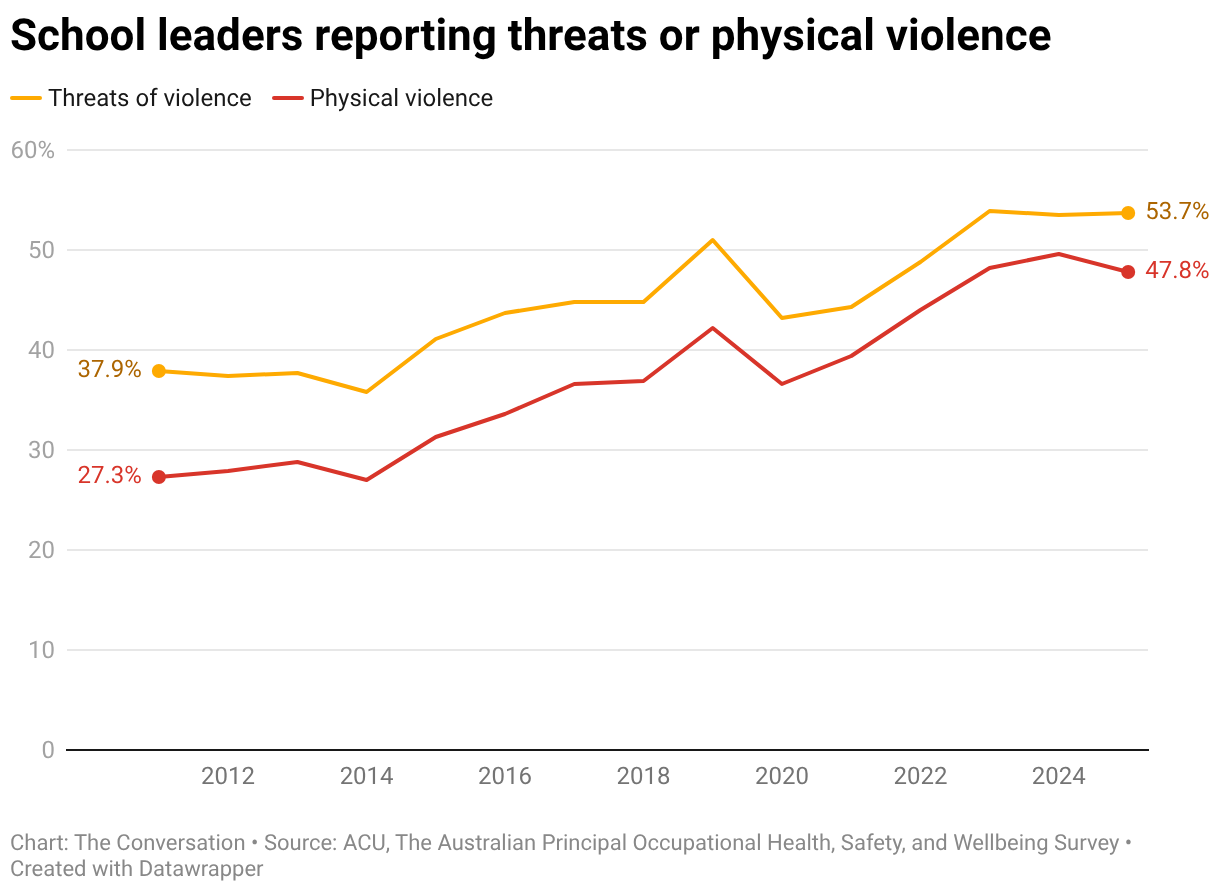
The latest findings paint a grim picture of the safety and respect afforded to those at the helm of our schools. In 2025, a concerning 49% of school leaders reported experiencing physical violence, while a further 54% faced threats of violence. The survey identified students as the primary perpetrators of physical aggression, with parents being the most frequent source of violent threats.
These statistics represent a significant upward trend since the survey’s inception in 2011. Such levels of violence would be deemed unacceptable in most other professional fields, highlighting a critical breakdown in respect and safety within the school environment.
Furthermore, the unacceptable behaviour extends beyond physical threats. A staggering 89% of principals reported encountering various forms of offensive conduct, including:
- Physical threats
- Sexual harassment
- Unpleasant teasing
- Cyberbullying
- Gossip
One primary school principal lamented the shift in their role, stating, “When I became a principal I didn’t expect to be mired in managing adult behaviour. I thought it would be about instructional leadership and inspiring educators. I didn’t realise how I would be subject to manipulation and need to respond like a lawyer – with extreme care and explicit language which leaves no room for interpretation.” This sentiment underscores a departure from the core educational leadership roles, with principals increasingly burdened by managing interpersonal conflicts and navigating complex behavioural issues.
The Unrelenting Workload and its Consequences
The demanding nature of the principalship is further illuminated by the extensive hours dedicated to the role. School leaders reported working an average of 53.9 hours per week during school terms, with an additional 19.6 hours spent on tasks during school holidays. This significantly exceeds the average Australian working week of approximately 38 hours.
While there has been a slight reduction in the number of principals reporting working 60 hours or more per week (down from 27% in 2011 to 22% in 2025), the overall workload remains exceptionally high. This relentless pressure is directly impacting the well-being of school leaders, with significant numbers reporting mental health concerns:
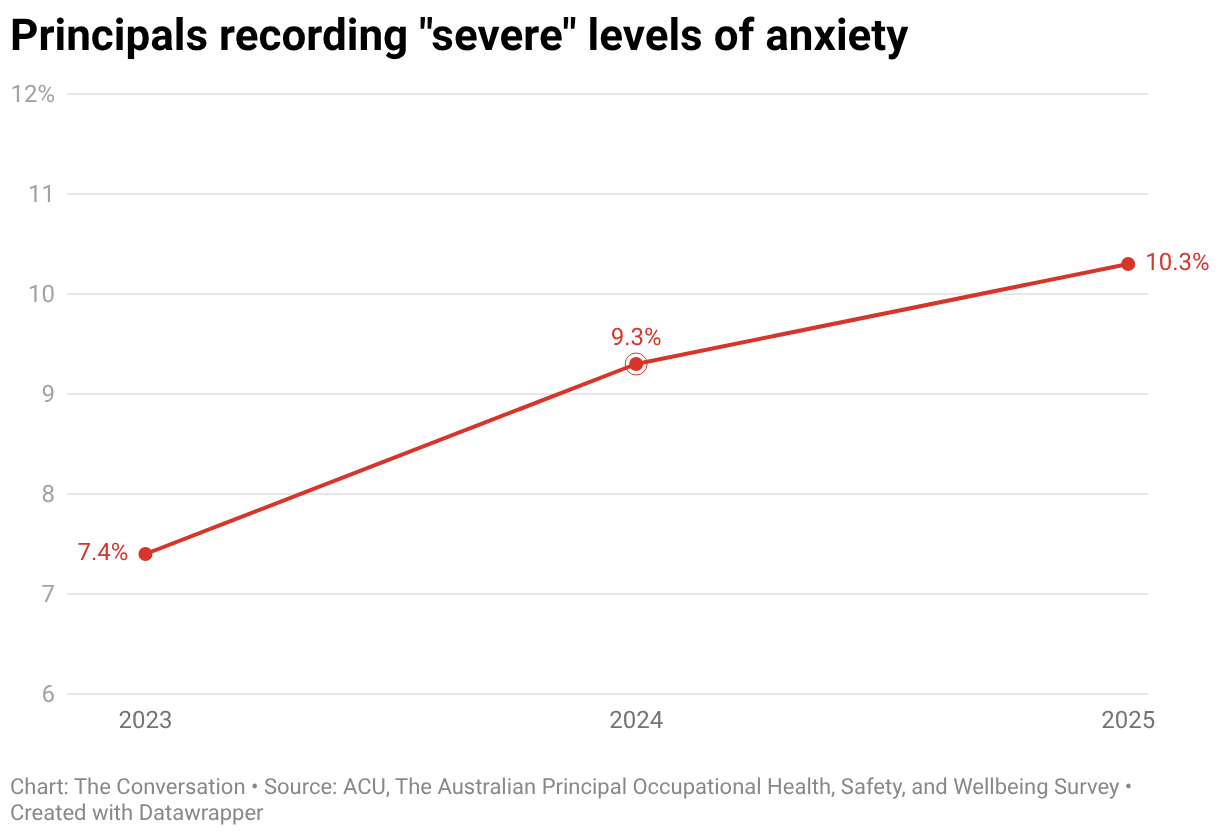
- 25% of principals scored at least a “moderate” rating for anxiety.
- 23% of principals scored at least a “moderate” rating for depression.
The psychological toll is evident in their career aspirations, with 54% of respondents agreeing or strongly agreeing with the statement, “I often seriously consider leaving my current job.” This figure represents a slight increase from the previous year, signalling a growing disillusionment with the profession.
A principal from a private high school articulated the immense pressure: “The challenges of reduced funding combined with growing expectations from all stakeholders make it more and more difficult to meet the demands of the role […] I am not sure how this will be sustainable for the next generation of principals.” This perspective highlights the systemic issues, including funding shortfalls and escalating demands, that are contributing to the unsustainable nature of the role.
Towards a Safer and More Supportive Environment
Acknowledging the severity of these issues, various governments and educational bodies have implemented measures to alleviate the pressures on school leaders. The Victorian, Queensland, and New South Wales governments have introduced initiatives aimed at reducing administrative burdens and promoting community respect for the teaching profession.
In a significant step towards addressing parental aggression, the NSW government recently enacted legislation, mirroring similar laws in Victoria. This legislation empowers schools to ban individuals who have engaged in threatening or abusive behaviour from school grounds, establishing a clear boundary and consequence for such actions.
The Urgent Need for Systemic Reform
Despite these efforts, it is clear that more comprehensive action is required to safeguard the well-being and professional sustainability of school leaders. The Australian Standard for Principals, first released in 2011, which outlines the expected knowledge, understanding, and actions for principals, is overdue for a review.
Recent reports indicate that student and teacher mental health have become significant sources of stress for principals. This critical factor is notably absent from the current standard, despite consistently ranking as a top concern for school leaders. A revised standard must explicitly address the mental health of teachers and the role principals play in supporting it.
Furthermore, the educational landscape and broader societal context have evolved dramatically since the standard’s inception. The findings of royal commissions into child abuse in school settings, the impact of the COVID-19 pandemic, and a growing awareness of the importance of managing young people’s screen time all necessitate an updated framework.
It is imperative to openly and honestly acknowledge that the role of a school principal has fundamentally changed. Our expectations and the support systems in place must be recalibrated to reflect this new reality. The welfare of principals is not merely an individual concern; their well-being has a profound impact on school culture, educational outcomes, and ultimately, the future prosperity of the nation. Investing in the health and resilience of our school leaders is an investment in the future of Australian education.