Unravelling the Nuclear Secrets: Epstein’s New Mexico Ranch and a Trump Ally’s Mysterious Communications Link
A groundbreaking report by veteran journalist and filmmaker Alisa Valdes-Rodriguez has unveiled a startling connection between the late financier Jeffrey Epstein, New Mexico’s highly sensitive nuclear weapons laboratories, and a prominent supporter of former US President Donald Trump. Valdes-Rodriguez’s investigation, meticulously pieced together from publicly available records, suggests that Epstein’s sprawling New Mexico property may have been equipped with a sophisticated private microwave communications system designed for surveillance of nearby nuclear facilities. The plot thickens as this system appears to have been maintained by the property’s recent purchaser, a significant figure within Republican circles.
Zorro Ranch: A Geographically Strategic Location
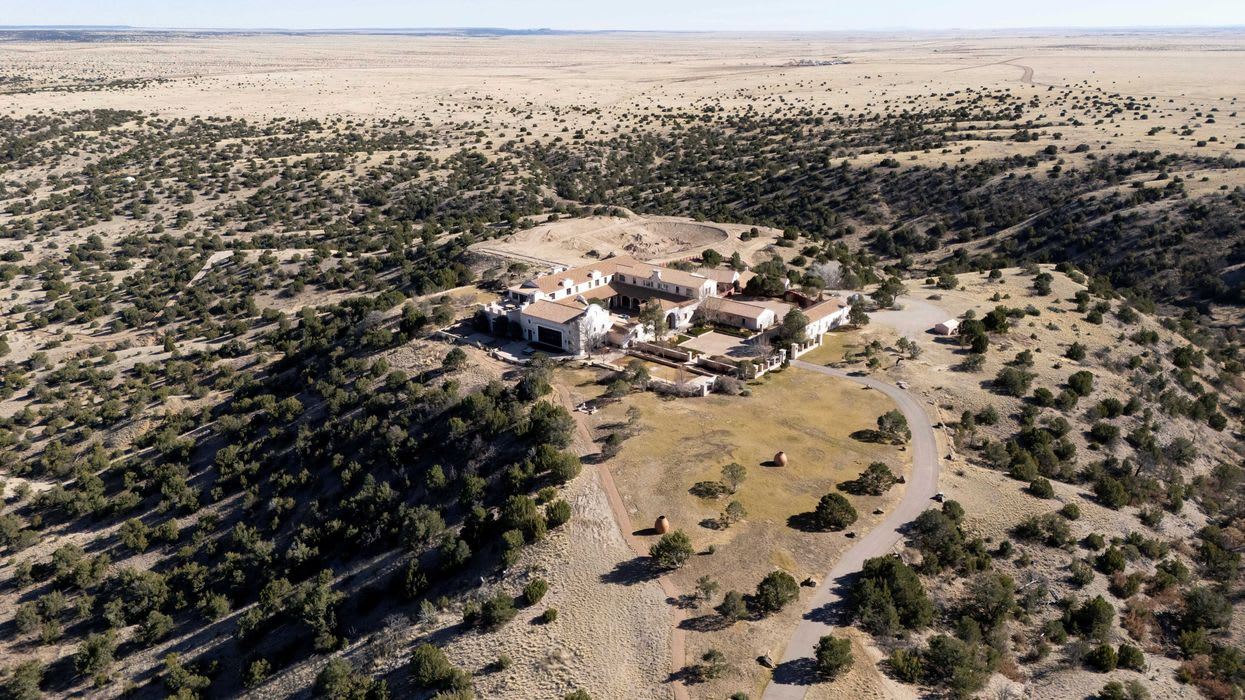
In 1993, Jeffrey Epstein acquired Zorro Ranch, an expansive 7,600-acre estate situated in New Mexico. Its location is geographically significant, lying precisely at the midpoint between two of America’s most critical nuclear research and development sites: Sandia National Laboratories and Los Alamos National Laboratory. Both are considered paramount to the nation’s nuclear weapons infrastructure.

Following Epstein’s death in 2019, the Zorro Ranch changed hands. In a move that remained under wraps until recently, the property was purchased in 2023 by Donald Huffines, a notable Republican candidate and a staunch ally of Donald Trump. Huffines’ son, Russell Huffines, was appointed to a role within the Trump administration last June, serving as associate director of agency outreach, a position he continues to hold.
A Sophisticated Communications Network
Valdes-Rodriguez’s deep dive into Federal Communications Commission (FCC) records has brought to light the existence of two active “Microwave Industrial/Business Pool licenses” granted to the Zorro Ranch property in 2016. These licenses are crucial for establishing advanced and secure data communication channels. Astonishingly, recent FCC data confirms that these licenses remain active.
“These licenses, in combination, establish a permanent, fixed, bidirectional private microwave communications link – essentially a dedicated two-way data channel that operates entirely independently of the commercial internet infrastructure,” Valdes-Rodriguez explained. “This means traffic flowing through these channels cannot be monitored, intercepted, or logged by external parties.”
The advanced communication system at Zorro Ranch possesses the capability to transmit data directly to a network of major communication towers located at Sandia Crest, a mountain ridge overlooking Albuquerque, New Mexico. This particular feature has raised significant red flags for Valdes-Rodriguez.
The Nature of Industrial Microwave Systems
To comprehend the implications of such an infrastructure, it’s vital to understand who typically utilises Industrial/Business Pool microwave systems. These are not common for private residences. Instead, they are the domain of highly secure government and corporate entities, including:
- National Security Agency (NSA) field stations.
- Central Intelligence Agency (CIA) operational facilities.
- Federal Bureau of Investigation (FBI) secure data operations.
- Department of Defense installations.
- Major utility companies (e.g., electric and natural gas pipeline operators).
- High-frequency trading firms.
- Large financial institution data centres.
“None of these descriptions align with the profile of a private vacation ranch located in a remote desert environment,” Valdes-Rodriguez observed.
The PROMIS Software and Robert Maxwell’s Legacy
The potential for Zorro Ranch’s advanced communication capabilities to have been leveraged for surveillance of the nearby nuclear facilities is further illuminated by two key elements: the late Robert Maxwell, father of Epstein’s associate Ghislaine Maxwell, and a sophisticated surveillance software known as the Prosecutor’s Management Information System, or PROMIS.
Developed in the late 1970s, PROMIS was a cutting-edge surveillance tool for its time, lauded for its ability to integrate and cross-reference vast amounts of data. Declassified records released in 2017 revealed that a copy of this software had been secretly provided to Israeli intelligence services. Valdes-Rodriguez notes that Israeli intelligence had “recognised PROMIS’s potential as a global surveillance weapon.”
Public records indicate that Robert Maxwell, at one point, acted as an Israeli intelligence “asset” tasked with distributing a “backdoored” version of the PROMIS software to governments and institutions worldwide. Further substantiating this, Valdes-Rodriguez asserts that Maxwell had also “sold backdoored surveillance software to Sandia National Laboratories in 1985,” a claim supported by a heavily redacted FBI document.
A Decade of Connection and Infrastructure
“A decade later, his daughter’s partner constructed a private, off-network communications link from the precise geographic centre between Sandia and Los Alamos, directly to a tower located at Sandia Crest,” Valdes-Rodriguez wrote. “The surveillance infrastructure that Maxwell embedded within Sandia, and the communications infrastructure that Epstein built to connect to it, are linked by their shared geography, by the Sandia Crest relay point, and by the ten-year relationship between Robert Maxwell’s daughter, Ghislaine, and Jeffrey Epstein himself.”
Adding another layer of intrigue, Valdes-Rodriguez points out that the current owners of Zorro Ranch, the Huffines family, have recently terminated “several FCC licenses on the property” in 2024 and 2026. However, they have deliberately chosen to retain the “microwave link to Sandia Crest.”
“This is unlikely to be an accidental omission, especially considering they did terminate three other FCC licenses,” she commented. “The peculiar aspect is why they have kept the two remaining licenses registered under the name of the late Epstein’s company, rather than transferring them to their own.” This decision, coupled with the nature of the retained licenses, continues to fuel questions about the true purpose and ongoing operation of the Zorro Ranch’s sophisticated communication network.