

A New Approach to Medical Imaging
Medical imaging has always been a paradox. The machines that save lives are often the least accessible. CT scanners the size of small cars. X-ray machines that demand entire rooms. Patients wheeled through corridors, losing precious minutes while clinicians wait for critical results.
In stroke care, those minutes matter more than most, because brain cells die quickly and diagnosis is what ultimately determines survival. But for decades, the model has largely been the same: take the patient to the machine.

Now, a small ASX-listed company out of Adelaide, Micro-X (ASX:MX1), is trying to flip that entirely. At the centre of Micro-X is a simple idea with complex physics behind it: making X-ray technology smaller and more portable.
Kingsley Hall, who stepped into the CEO role in April 2023 after joining as CFO in 2020, explains it in a way that cuts through the technical jargon.
“At the heart of our business has been our ability to miniaturise X-ray technology.”
Traditional X-ray systems, he explained, rely on heat. A filament is heated to extreme temperatures to generate electrons – a process that requires cooling systems, bulky hardware and time. Micro-X takes a different approach.
“Our tubes have the same output in that it generates an X ray, but we do it using a carbon nanotube based emitter to generate electrons, instead of a hot filament.”
The company calls this its NEX technology, a cold cathode system that replaces heat with electrically controlled carbon nanotube emitters. Instead of heating a filament, Micro-X applies a high voltage across millions of nanotubes on a tiny emitter, causing them to release electrons instantly and in a controlled way.
“The beauty about our device is, because it requires no heating, it therefore requires no cooling, so it’s materially smaller than a traditional X ray tube.”
That shift removes two of the biggest constraints in conventional systems – heat and cooling- which are what make traditional X-ray machines large, heavy and fixed in place. By eliminating both, Micro-X can shrink the hardware down to something far lighter and more mobile, opening up use cases well beyond the reach of traditional imaging systems.
Taking Imaging to the Patient
And if there’s one theme that runs through Micro-X’s entire strategy, it’s mobility. “Mobility is incredibly important, because what our technology allows us to do is take the imaging to the patient, rather than the patient to the imaging,” said Hall.
That shift especially matters in time-critical situations like stroke, where diagnosis depends on a CT scan to determine whether the patient is suffering a clot or a bleed. Treatment can’t begin until that distinction is made.
The company’s head CT scanner is being designed to fit into the side wall of an ambulance and is planned to weigh under 75kg. Subject to clinical testing, it aims to bring diagnostic CT imaging to the patient.
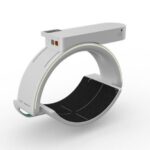
Head CT. : Micro-X
Traditional mobile stroke units, meanwhile, are effectively small trucks carrying full-sized CT scanners – heavy and expensive to operate. Micro-X’s approach is far lighter and faster to deploy.
“It could attend to a stroke patient very, very quickly… within a fraction of the time they would normally need to get to a hospital.”
In practical terms, that speed means earlier diagnosis and faster treatment decisions. “Yes, that’s the whole point. It saves lives.”
Rover: Proof it works in the real world
While much of Micro-X’s story is about what’s coming, it already has a commercial foothold. Its Rover mobile X-ray system is in the market today, used across hospitals, military settings and even professional sports.
Lightweight, battery-powered and highly portable, the Rover reflects the same core philosophy. “It is so lightweight at 100 kilograms, it’s easy to manoeuvre. It’s incredibly reliable. It’ll run all day off a battery.”
More importantly, it’s validating demand. Micro-X has sold more than 400 units across 38 countries – a critical proof point that its technology is usable. Recent traction in Southeast Asia, including orders from the Malaysian Ministry of Health, is building a base of reference sites.
The company recently reported record half-year revenue of around $10 million, alongside more than $90m in partner funding and contracted payments.
CT is Where This Story Gets Bigger
If Rover proves the concept, CT is where the scale sits. Micro-X is developing two major CT platforms: a head CT for stroke diagnosis, and a full-body CT backed by the US Government’s ARPA-H program.
The head CT is already moving into human imaging trials at Royal Melbourne Hospital. “What we’re looking to demonstrate is that the images taken by our device are equivalent to hospital-grade CT for diagnosing whether the stroke is a clot or a bleed,” Hall explained.
It’s a high bar, but the payoff could be significant. “It’s a really fast growing market… and we see the opportunity to take stroke diagnosis to a mobile platform as really significant globally.”
The company’s full-body CT takes the same concept further. Instead of a spinning gantry, Micro-X uses an array of small X-ray emitters, switching them on and off digitally to reconstruct a 3D image.
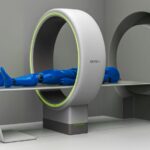
Full-body CT. Pic: Micro-X
“The current development program aims to put a unit in the back of a van and have it travel around regional America, providing CT quality imaging for parts of the country that can’t currently access CT.”
It’s the same idea again: bring the machine to the patient.
Security Adds a Second Layer of Value
Running alongside the medical push is a less visible, but already validated, security business. Micro-X has spent years developing airport checkpoint and baggage scanning systems, backed by the US Department of Homeland Security (DHS) in a contract worth up to $31 million.
That level of backing signals real-world credibility, with systems being tested for frontline use. The Company’s strategy on this side of the business is to monetise the capability without diverting focus from healthcare.
Recent deals show how that plays out, with Micro-X retaining its core IP while supplying key components into deployed systems.
A Capital-Light Way to Build Deep Tech
For investors, one of the more interesting aspects of Micro-X isn’t just the technology, it’s how the company is funding it. Rather than burning capital internally, major development programs are backed externally.
For example, the US DHS is funding its security scanning projects. ARPA-H is funding full-body CT development. The Australian Stroke Alliance and government grants are supporting the head CT.
“Most of our major development work is funded by partners,” said Hall. That allows Micro-X to focus its own capital on commercialisation – particularly scaling Rover and, eventually, CT.
What Comes Next
After years of development, Micro-X appears to be approaching a shift. “We’re the first and only company in the world to be able to commercialise Carbon Nanotube based X ray technology for healthcare,” Hall said.
The next phase is about execution. Rover continues to scale. Head CT moves through trials and regulatory submission, while the full-body CT advances under US funding.
If those pieces land, the business trajectory could change from development to deployment. “Success in two years time will look like a lot more Rovers in circulation around the world and head CT – both in hospitals and in the back of ambulances – saving people’s lives.”
Micro-X isn’t trying to compete head-on with the giants of medical imaging. Instead, it’s focused on building into the gaps they can’t easily serve.